


 © A.Schneider
Project coordination: Dr. Almut Schneider
Duration: since February 2026
Foundation: Adickes-Foundation
The Biocultural Diversity Network focuses on the relationships through which biological and cultural diversity emerge – and in which they are continually transformed. For us, biocultural diversity is not a condition simply found in a particular place. It takes shape and changes through relationships: between people, plants and animals; between knowledge and practice; between historical traces and present-day interventions; and between what is protected, cared for, mapped, collected – or overlooked.
The network brings together researchers from Frankfurt and the Rhine-Main region who explore such relationships from different disciplinary perspectives. It draws on approaches from social and cultural anthropology, biology and botany, archaeology and archaeobotany, literary and cultural studies, as well as biodiversity research, conservation and related fields.
We understand Frankfurt and the Rhine-Main region not simply as the location of the network, but as a shared space of research and resonance. Gardens and green spaces, river landscapes, wastelands and pastures, herbaria, archives, collections and scientific gardens all tell us something about how nature is perceived, ordered and brought into being. The city thus appears both as a habitat and as a multilayered archive: a place where ecological processes, human interventions, the movements of species and knowledge, memories, plans and visions of the future accumulate and overlap.
We are therefore less interested in arriving at a fixed definition of “biocultural diversity” than in asking how biological and cultural diversity are related to one another: How are landscapes and habitats cared for, transformed and valued? What becomes visible when different disciplines look at the same place? Which forms of knowledge complement one another – and where do frictions remain?
We pursue these questions together: through field and archive days, exploratory projects, conversations and public events, but also through shared ethnographic walks and on-site explorations. Walking together reveals how many different readings one and the same place can sustain – and what only becomes visible through exchange. Methods and disciplinary approaches are invited to respond to one another. It is precisely from this interaction that new questions, new perspectives and forms of collaborative research can emerge.
For more information, please contact:
Almut Schneider
Members
 © K.Witt
Prof. Dr Roland Borgards, Modern German Literary Studies, Goethe University Frankfurt
Roland Borgards comes from literature to animals. As a literary scholar, he studies literary texts in their relationships to the history of knowledge, to social processes and to political positionings. His focus is above all on animals as multimodal existences. The look into a nightingale poem, the data of biological nightingale research, the experience of a nightingale night, the protection of a nightingale habitat – all of this is interwoven in the sense of biocultural diversity.
This becomes apparent in individual animal species (such as the nightingale), in individual authors (a hundred different animal species in Georg Büchner!) or in specific ‘naturecultures’ (a river with its human and more-than-human living beings). In literary history there are some particularly relevant epochs, such as Romanticism with its proximity to the philosophy of nature (Naturphilosophie), or the Anthropocene present with genres such as climate fiction or nature writing.
In the Biocultural Diversity Network, his main aim will be to determine the role of literature and literary studies for socio-ecological transformation processes. Does it make a difference – and indeed a difference for our planetary community – whether nightingale poems are read or not? There is not yet an established set of methods for such questions. It is precisely this that is to be developed within the network as Transformative Literary Studies.
Prof. Dr. Borgards at Goethe-University
Prof. Dr. Borgards at Forschungskolleg Humanwissenschaften
 © W.Kewlin
Prof. apl. Dr. Susanne Fehlings, Frobenius Institute for Research in Cultural Anthropology
Susanne Fehlings comes from bazaars and urban landscapes to trees and gardens. As a social anthropologist, she is interested in how people live with plants and in the cultural worlds that unfold around them. Pomegranates and other tree species have become a particular focus of her work. Her research has taken her across post-Soviet Eurasia: to Crimea, Central Asia, and the South Caucasus. During extended periods of fieldwork, she explored cemeteries, bazaars, and rapidly changing cities. These places reveal how history continues to shape everyday life and how relationships between people, other living beings, things, and ideas change over time.
Within the Biocultural Diversity Network, she turns her attention to domestic and allotment gardens in Frankfurt. Together with others, she wants to explore what grows there – and how it gets there. What is planted, what is allowed to remain, and what simply grows alongside? She is interested in how cultural ideas and everyday practices produce and transform biodiversity. In this way, gardens become places where far-reaching relationships are condensed into just a few square metres.
Prof. Dr. Susanne Fehlings at Frobenius-Institute
Prof. Dr. Susanne Fehlings at the Department of Social and Cultural Anthropology
 © A.Ivanov
Dr. Felix Gaschick, Frankfurt Conservation Center (FCC)
Felix Gaschick starts from international conservation practice and turns to Frankfurt. His perspective on biocultural diversity centres on the question of how nature and its conservation can be more firmly embedded as a foundation for social and economic action. He is interested in how biodiversity is connected with local and Indigenous knowledge, cultural practices, social structures, and political and economic decision-making.
For many years, he worked in international development cooperation and conservation, mainly in Asia. In the Philippines, his work included Indigenous knowledge of tree species and the documentation and transmission of this knowledge. Drawing on these experiences, he coined the term “de-projectisation of conservation”. By this, he means embedding nature, biodiversity and their conservation more permanently in social, cultural, institutional and economic structures.
Today, Felix heads the Frankfurt Conservation Center. For him, the Biocultural Diversity Network embodies precisely the kind of collaboration that the FCC seeks to advance in Frankfurt: researchers and practitioners from different disciplines and institutions bring their perspectives together, develop shared questions, and then work jointly towards answering them.
Dr. Felix Gaschik at the Frankfurt Conservation Center
 © A.Schneider
Prof. Dr. Roland Hardenberg, Frobenius Institute for Research in Cultural Anthropology
Roland Hardenberg comes from the study of the cultural significance of resources to biocultural diversity. As a social and cultural anthropologist, he assumes that the categories “nature” and “culture”—and their equivalents in various languages—are expressions of different cultural classifications of the relationships between people and their environment. Our task as cultural anthropologists is, among other things, to describe this diversity of cultural constructions of the world and to highlight their relevance for social coexistence and our relationship with the environment.
For example, in India, he has conducted research on the cultural conceptions of and approaches to millet and rice in the lived worlds of both Hindu farmers and animist shifting cultivators. Roland brings to the network insights into the diverse, and at times radically different, ways of perceiving and interacting with “nature”. At the same time, he hopes to gain from the network a better understanding of the diverse characteristics of plants, animals, and geological phenomena on which the various constructions of the world are based.
Prof. Dr. Roland Hardenberg at Frobenius-Institute
Prof. Dr. Roland Hardenberg at the Department of Social and Cultural Anthropology
 © A.Schneider
Dr. Julia Krohmer, Scientific Coordination, Senckenberg Society for Nature Research, Frankfurt
Julia Krohmer starts from the West African savannas and turns to urban nature. As a botanist and geoecologist, she is interested in how people perceive, distinguish and value biodiversity – and in how perception, knowledge and cultural patterns of classification intersect.
In her doctoral research at Goethe University Frankfurt, she studied environmental perception and classification among different Fulbe groups in Burkina Faso and Benin. For many years now, her attention has focused closely on Frankfurt and the Rhine-Main region. Her work centres on plants and trees in urban environments and on the question of how their diversity can be made visible, communicated and valued by society. In participatory projects such as Krautschau and the completed MainStadtbaum project, she has explored often overlooked forms of urban nature, bringing research, urban communities and local initiatives into conversation.
As a science coordinator at Senckenberg, Julia Krohmer works at the interface of research, knowledge transfer and networking. She enriches the network with her botanical perspective, but above all with her many years of experience in participatory formats and her extensive knowledge of Frankfurt’s biodiversity landscape. This also opens up ways of exploring how plants and urban habitats are perceived, valued, communicated and conserved.
Dr. Julia Krohmer in Science coordination Senckenberg
Link to the project "Krautschau"
 © D.Frank
Prof. Dr. J. F. Niek Scheepens, Evolutionary Plant Ecology, Goethe University Frankfurt
Niek comes from the adaptability of plants to the diversity that emerges in urban gardens. As an evolutionary ecologist, he studies how plants respond to changing environmental conditions – through phenotypic plasticity and evolutionary adaptation. He is particularly interested in how quickly such processes take place and where their limits lie.
To this end, he combines field and greenhouse experiments with population genetic approaches. In so-called resurrection ecology, for example, he grows decades-old seeds from seed banks together with present-day descendants of the same populations. This makes visible how plants have adapted to changing conditions within just a few decades.
In the Biocultural Diversity Network, Niek turns this perspective to Frankfurt's allotment gardens. Together with anthropologists, he aims to investigate what is grown there, how the diversity of cultivated plants differs between gardens, and what relationships exist between plant choice, use and cultural experiences. Plant-ecological and ethnographic approaches are to be deliberately brought into relation with one another. In this way, allotment gardens become places where biological diversity, everyday practices and cultural exchange can be observed in close quarters.
Prof. Dr. J. F. Niek Scheepens Department at Goethe-University
 © A.Evans
Dr. Almut Schneider, Project Coordinator, Biocultural Diversity Network, Frobenius Institute for Research in Cultural Anthropology
Almut Schneider starts from grasslands and turns to the city. As a cultural anthropologist, she is interested in landscapes as constellations of living relations between people, animals and plants, work and care, political decisions and historical change.
Her research in the European Alps began in South Tyrol, with meadows, mountain farmers and dairy farming. From there, she moved one altitudinal zone higher: to the alpine pastures of Switzerland, to shepherds and sheep. Together with ecologists, she studied the biodiversity of these grasslands; ethnographically, she asked how it is entangled with land use, knowledge, values and political regulations. In this sense, the biodiversity of these landscapes tells a story of the relationships that have shaped them over time – and whose transformation is now contributing to its decline in many places.
Within the Biocultural Diversity Network, she brings this perspective to Frankfurt/Rhine-Main. She is interested in the life histories of urban places and, in particular, in peri-urban pastoralism: in sheep and shepherds at the edges of the city, and in landscapes that are created and sustained through grazing.
As coordinator of the network, she brings researchers from different disciplines into conversation. At its heart is a question: What happens when different disciplines look at the same place – and do not see the same thing?
Dr. Almut Schneider at Frobenius-Institute
 © Labor für Archäobotanik
Prof. apl. Dr Astrid Stobbe, Laboratory for Archaeobotany of Europe and Western Asia, Goethe University Frankfurt
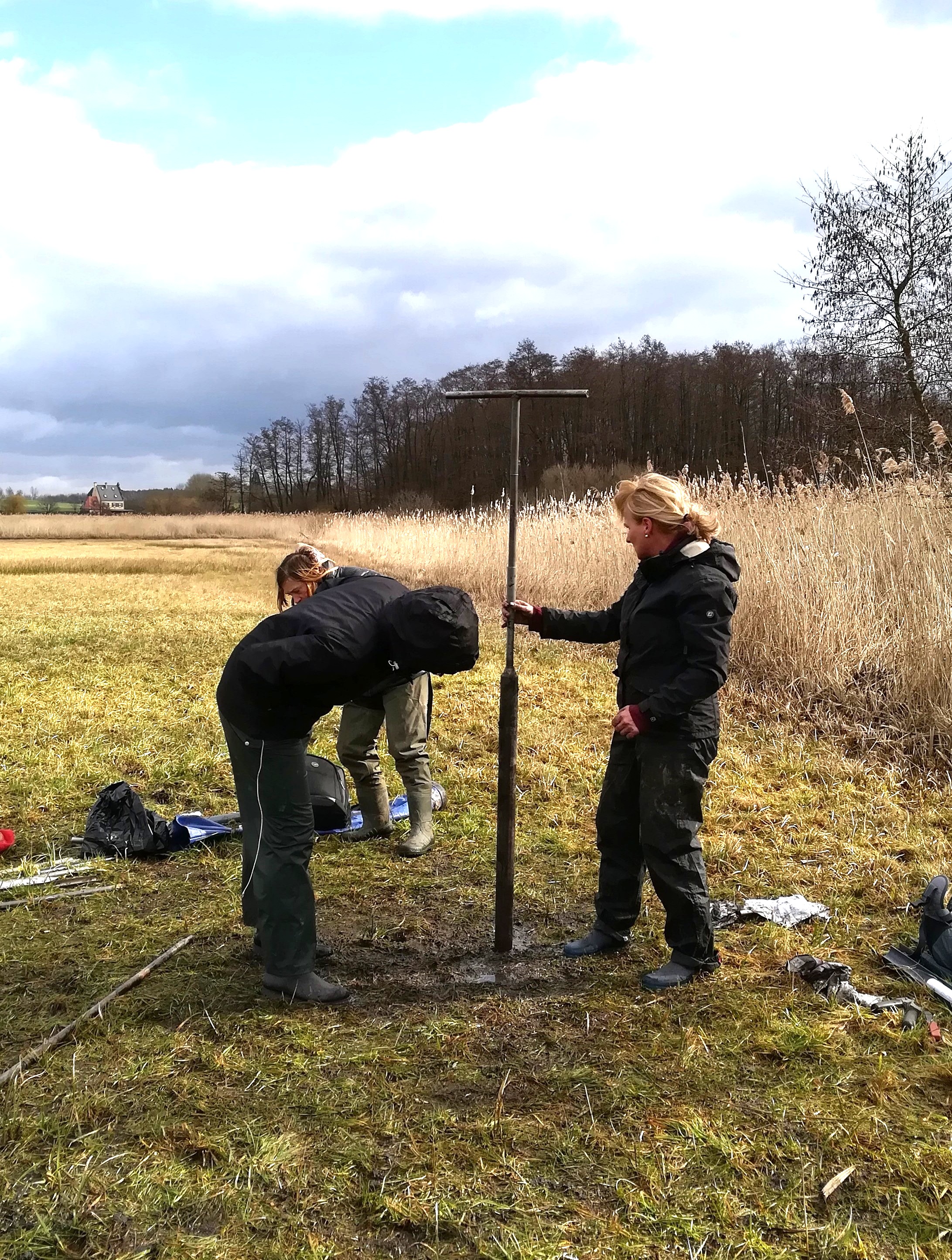
Astrid Stobbe comes from pollen and seeds to the histories of entire landscapes. As an archaeobotanist, she works at the intersection of biology and archaeology. Her research explores relationships between people and their environments: How have humans transformed landscapes – and how, in turn, have environmental conditions shaped human life? Using fossil pollen, seeds, and fruits, she investigates diet, land use, and landscape change, as well as the effects of environmental transformations on settlement patterns and economic systems.
Her research spans the past 10,000 years and reaches across different regions of the world, with a particular focus on the Eurasian Steppe, the Carpathian Basin, the German Central Uplands, and the Rhine-Main region. The latter is a long-settled landscape that has been used for agriculture since the Neolithic period, around 7,500 years ago.
Within the Biocultural Diversity Network, Astrid is particularly interested in how biodiversity has changed over time – and how millennia of human use and intervention have shaped the landscapes and biological diversity of Frankfurt and the Rhine-Main region.