

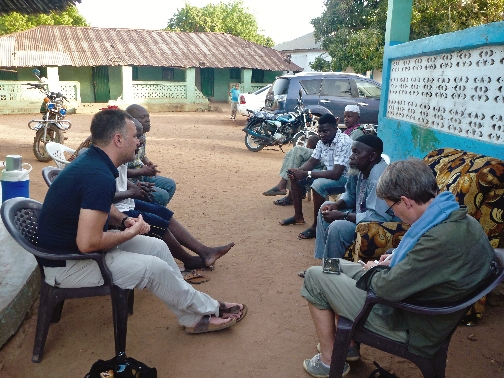
 Photo: Nikolas Gestrich
Project Staff: Esther Morgenthal (University of Hamburg), Søren Feldborg Pedersen
Funding duration: April 2019 – May 2026
Funding: German Research Foundation (DFG), Priority Programme "Entangled Africa"
The population structure in the lower middle reaches of the Niger River (downstream from Gao) is characterized by enormous diversity. In the region stretching from northern Mali to the Kainji Dam in Nigeria, languages from a total of three language phyla are spoken by a large number of different ethnolinguistic groups. What are the historical causes? While historical sources provide evidence of the significance of early kingdoms (Kawkaw, Kanem-Bornu, Songhai, Hausa, Oyo), oral traditions recount migratory movements, and archaeological research confirms the importance of trade, the cultural dynamics and the origins of the population structure remain largely unknown. However, the existing data and sources suggest that this region held particular historical significance for the political and economic development of large parts of West Africa. In our view, the Niger River served a special function as a corridor for exchanges of all kinds and as a link between the edges of the Sahara and the rainforest. This enabled and gave rise to the mutual influence of cultural processes, leading to new languages, new identities, and new material forms. Over time, this ultimately resulted in the complex ethnolinguistic situation we find today.
Science Clip
Connecting the lower middle Niger through borrowed words and shared objects
In spring 2020, the team was able to conduct important archaeological and linguistic research in Mali.
Filmed in Mali by the team of the project "Connecting the lower middle Niger through borrowed words and shared objects"